Dosage, not duration
Medical Massage: Twenty Minutes on the Muscle That Actually Hurts
One segment, worked hard, and documented — so the next visit starts where this one ended.
Dr. Joshua L. Penner, DC · Inside Tree of Health
Mondays & Fridays · Insurance & PIP accepted
Booking are listed as Medical Massage. The slot runs 30 minutes — about twenty of hands-on work, the rest exam and plan. A first visit runs 45.
No contracts · No prepaid plans · No separate appointment
No pressure to keep scheduling · No six-month plan

Twenty focused minutes, aimed at a segment the exam flagged.
No review below five stars
Google reviews for Dr. Penner on the SoundCare Chiropractic Woodinville profile: Same hands, same room, same person who does the soft-tissue work.
Dr. Penner is exceptional! I came to him three months ago dealing with frequent headaches, severe neck stiffness, and a tight upper back. Today, my headaches are completely gone, my neck mobility has improved drastically, and I’m sleeping better than I have in a long time.
Dr. Penner is incredibly gentle, knowledgeable, and insightful in his approach. Seeing such steady, solid progression over the past few months has been incredibly uplifting and restored my confidence. I highly recommend Dr. Penner.
Matt B. ·

I’ve seen Dr. Penner off and on for years now and have always been given good information and received the appropriate treatment that involved only a necessary amount of visits—no pressure to come for weeks and weeks if things were improving; which they always did. Dr. Penner has a calm and friendly manner and is a great communicator.
Deborah Ferguson ·
Dr. Penner consistently nails it every time. I know I can come to him for amazing care and quality!! I always leave his office feeling so much better!!
Sara Adkisson ·
We are inside Tree of Health.
SoundCare Woodinville operates inside Tree of Health Integrative Medicine in downtown Woodinville. There is no standalone SoundCare storefront to find, so if you are standing outside looking for one, this is the part worth reading.

The Tree of Health entrance, downtown Woodinville. This is the door.
What people mean when they look for “medical massage”
No one wants a specific technique.
They want three things.
Someone to figure out why it keeps coming back
Not just quiet it down until Thursday.
Work aimed at the actual problem
Not distributed politely across their whole back.
Something that holds
Longer than four days.
Those are reasonable expectations. It just doesn’t describe a massage; it describes a diagnosis and a plan, with hands-on work as one part of it.
Soft tissue usually isn't the problem. It’s the response to the problem.
When a joint isn’t moving properly, the muscles around it tighten to protect it. That’s not a malfunction; that’s the correct response.
Release the muscle and leave the joint alone, and the muscle comes back. It has to. Nothing has changed about the reason it tightened in the first place. This is the Thursday problem, and it’s not a failure of the massage — the massage did exactly what massage does.
Move the joint and leave the muscle alone, and the joint gets pulled back. This is why some people find that adjustments feel great for a day and a half. The cable running alongside that segment is still short, still guarding, and still winning.
One treatment with two halves. Not two appointments.
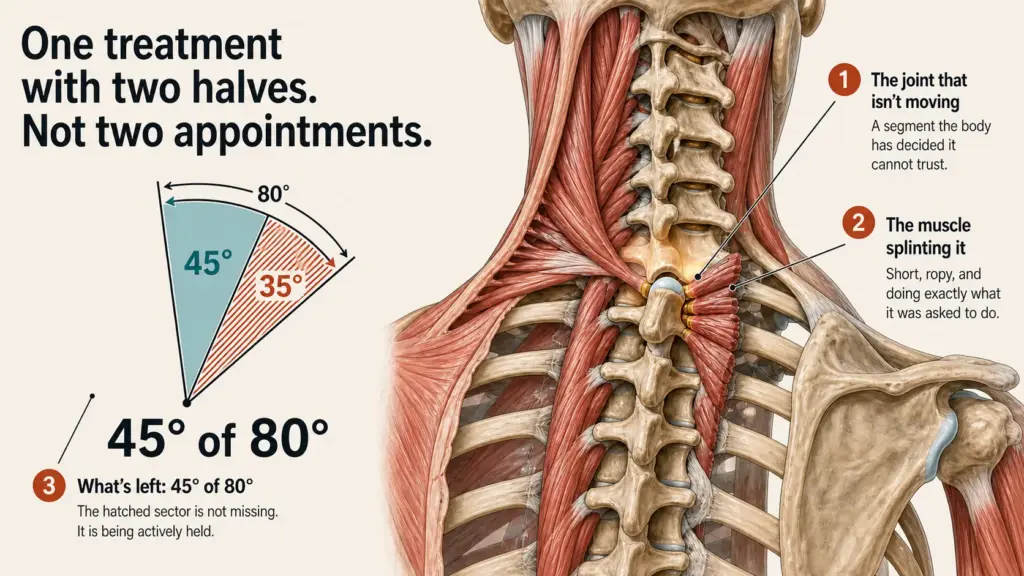
The joint that isn’t moving
A segment the body has decided it cannot trust.
The muscle splinting it
Short, ropy, and doing exactly what it was asked to do.
What’s left: 45° of 80°
The hatched sector is not missing. It is being actively held.
The tight, ropy band you keep asking someone to dig out is your body splinting a joint it doesn’t trust.
Six kinds of hands-on work, in plain English.
Plain descriptions, because “advanced soft tissue modalities” tells you nothing.
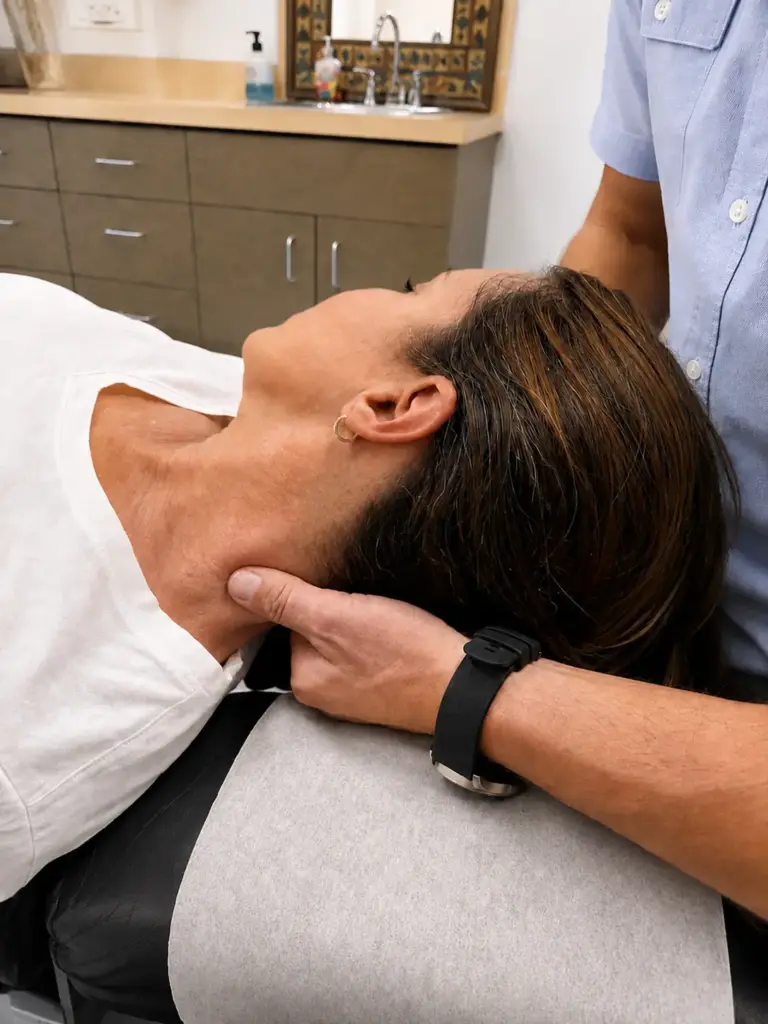
Sustained elbow pressure, lumbar paraspinals.

Pin and stretch, calf.
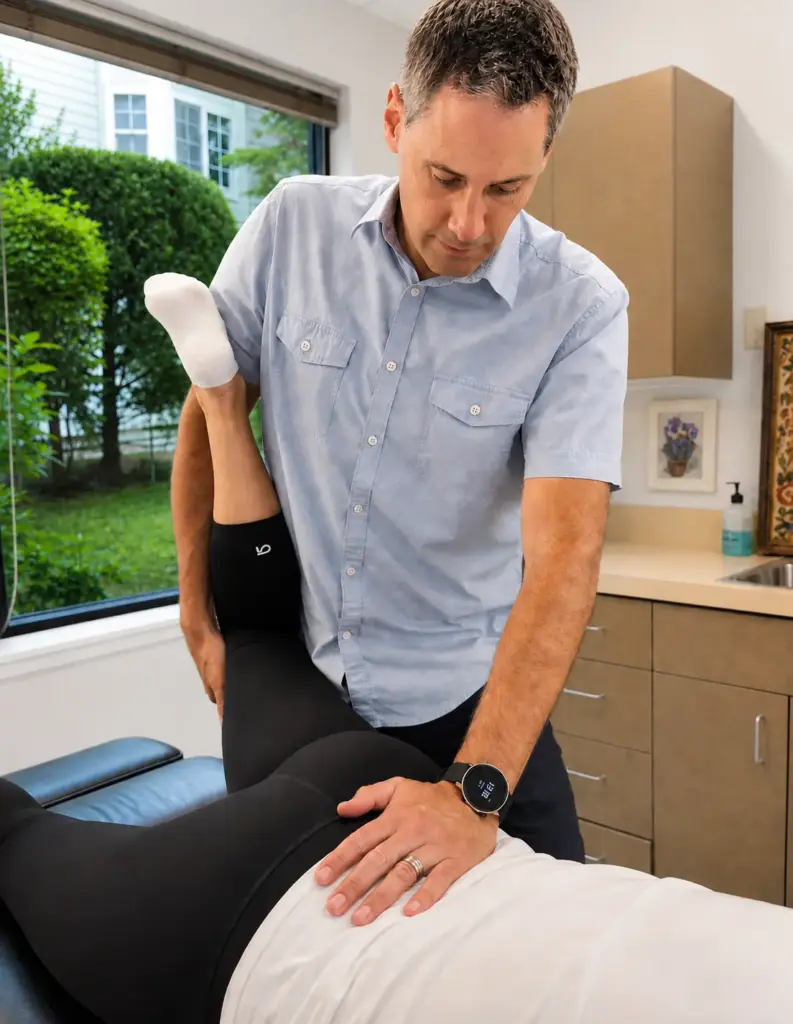
Prone hip and low back, taken through range.
Trigger point work
Sustained pressure into a specific knotted band until it releases. It often reproduces the referred pain you came in about — which is how you both know it’s the right spot.
Myofascial release
Slow, low-force loading of the connective tissue wrapping the muscle rather than the muscle belly. Undramatic to watch. Frequently the thing that moves a stubborn case.
Cross-fiber friction
Work applied across the grain of a tendon, typically for chronic irritation that has stopped resolving on its own.
Muscle energy technique
You contract against resistance, relax, and the new range gets taken up. A negotiation with your nervous system, not a stretch you’re losing.
Instrument-assisted work
A hard-edged tool run along tissue where fingers can’t localize well. It can leave temporary redness or mild bruising, and you should be told that beforehand rather than discovering it in the mirror.
Positional release
The muscle is shortened and supported until the guard drops. Very gentle, and often the only thing tolerable for someone acutely injured a few days after a collision.
Which of these you get is a clinical decision made from your exam. Not a menu item you choose.
Whiplash, neck-driven headaches, low back guarding, overuse.
After a car accident. Whiplash is a soft-tissue injury before it’s anything else. The joints get the attention, but the muscles that seized to protect your neck at the moment of impact are usually why you’re still stiff two months later.
Headaches that start in your neck. Not headaches generally — and any clinic claiming to treat headaches full stop is overreaching. But headache patterns related to neck tension and joint irritation are a common presentation, and the suboccipital and upper trapezius tissue involved responds to focused work.
Low back pain with visible guarding. The kind where you can see one side of the paraspinals standing up like a cable. Adjust that joint without addressing the cable and you have a temporary result by design.
Overuse and sport injuries. Tendon-adjacent irritation from running, lifting, climbing, or eight hundred consecutive hours at a desk. Slow-onset problems that respond to repeated, dosed work far better than to one heroic session.
Anything that keeps returning to the same square inch. The most useful signal here: if you can point at the spot, and you’ve been pointing at the same spot for months, you have a specific problem and it should be specifically examined.
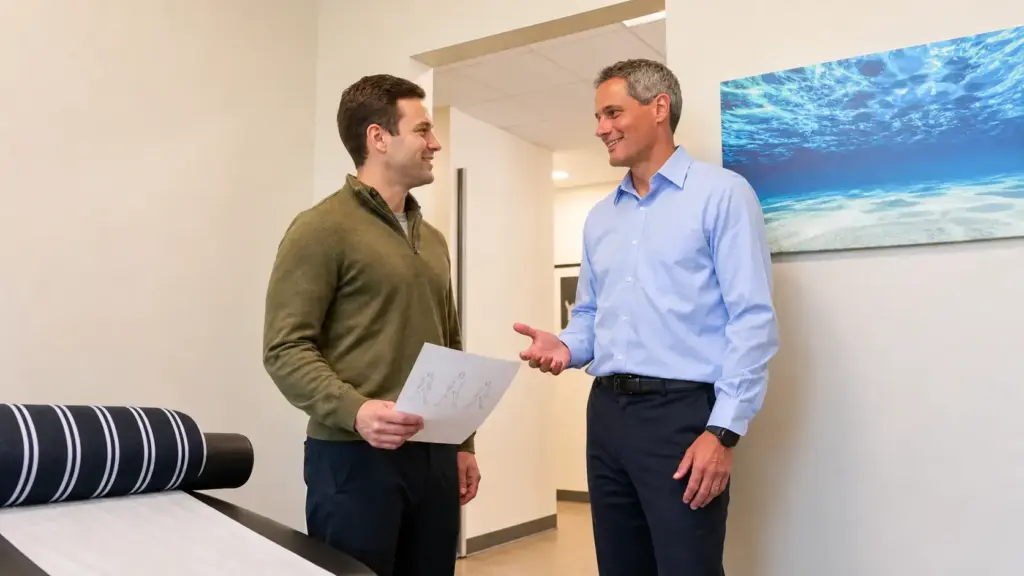
Slow-onset problems respond to repeated, dosed work — and to what you do between visits.
The part nobody tells you: this is often billable.
The short version: because this is chiropractic care delivered under a diagnosis and a treatment plan, it’s a clinical encounter rather than a retail purchase — and clinical encounters are the kind of thing insurance is built to pay for. Whether yours pays is a different question, and it depends on your plan, your diagnosis, and this clinic’s contracts.
After a car accident. Washington insurers are required to offer Personal Injury Protection of at least $10,000, and PIP typically carries no deductible and no copay — it pays covered medical expenses up to the limit regardless of who caused the crash. Chiropractic care for collision injuries is commonly covered under it. If you were rear-ended and you’ve been quietly paying cash to manage the whiplash, there’s a real chance you’re buying something your own auto policy already covers.
Ordinary health insurance. Washington has an unusual statute — the “every category of provider” law. Broadly: if your plan covers treatment for a condition, it generally can’t categorically exclude a licensed provider type whose scope includes treating that condition. Network status, visit limits, deductibles, and prior authorization all still apply. But it’s a better starting position than patients get in most states.

Rear-ended near Woodinville? Ask about PIP before you pay cash.
The distinction underneath all of this: a spa visit produces a receipt. A clinical visit produces a documented, coded encounter with a diagnosis and a record of functional progress attached. That’s real administrative work. It’s also the entire reason the visit can be reimbursed and, if questioned, defended.
Ask before you assume — in either direction. The default belief that this is never covered is wrong often enough to be expensive.
How to tell whether you’re in treatment
A treatment plan has four parts. If you can’t get all four said out loud, you don’t have one.
A named problem
Not “tension.” A region and a working diagnosis.
A frequency and a duration, with a number attached
Usually front-loaded and tapering. “Come in when you feel like it” is a habit, not a plan.
A goal you’d actually notice
Turn your head to back out of the driveway. Sleep through the night. Sit through a meeting. Function, not a number on a pain scale.
A reassessment date
Where the plan continues, changes, or ends.
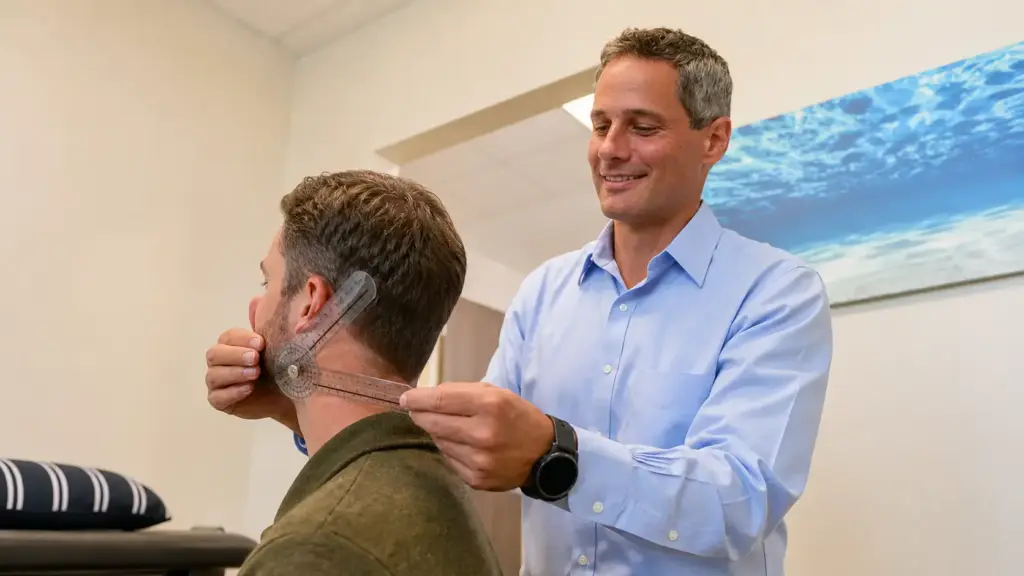
Cervical rotation, measured. That is what a reassessment date is for.
Hold people to the fourth one. A treatment plan is supposed to have an end.
If nobody can tell you what “done” looks like, you’re not in a treatment plan — you’re on a subscription.
Two more signals. You should leave with something to do between visits: hands-on work opens a window, and two or three simple exercises are what keep it open. A clinic that gives you no homework is charging you to reopen the same window every week. And if you’re not clearly better within a handful of visits, the right response isn’t more of the same at higher frequency — it’s a different approach, an image, or a referral to someone else.
What the first visit looks like
History and exam, before anyone touches you
You’ll be asked what makes it worse, what makes it better, and — the question that matters most and gets asked least — what you can’t do right now that you’d like to be able to do.
A plan, stated in the four terms above
A named problem, a number, a goal you would notice, and a date to check it.
Treatment, in this order
Soft-tissue work on the segment that’s actually failing, then the adjustment. In that order, and for the reason described further up.
Homework, and a date to find out whether any of it worked
Two or three things. Not a program.
One phone call is the useful next step.
If you’ve been paying out of pocket for massage that keeps wearing off, describe what keeps coming back and ask whether it’s the kind of thing an exam would explain. Worst case, you find out it isn’t. Best case, you stop paying every three weeks to treat the same symptom.
No contracts · No prepaid plans · No separate appointment
No pressure to keep scheduling · No six-month plan
SoundCare Chiropractic · Woodinville
17924 140th Ave NE, Suite 100, Woodinville, WA 98072
inside Tree of Health Integrative Medicine
Monday 9–5 · Friday 9–4. Two days a week, so slots go fast.